Why We Don’t Trick Your Team With Fake Phishing Tests (And Why You Shouldn’t Either)
Your team deserves training, not a surprise exam. Why tax and accounting firms don’t need fake phishing tests to meet federal training rules.
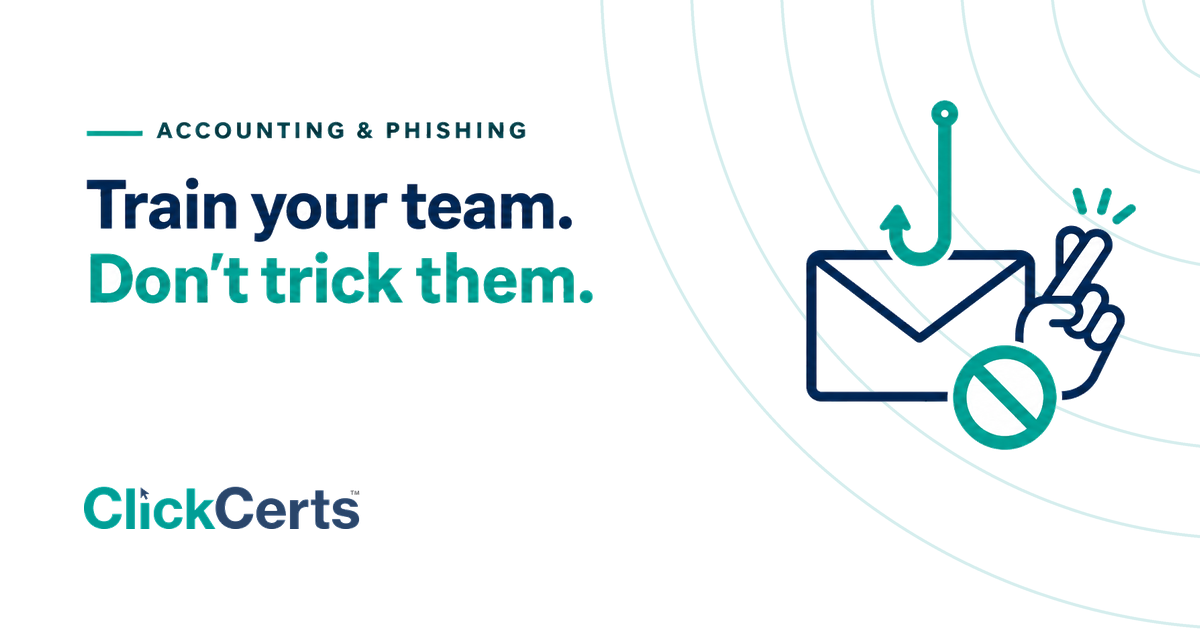
If you run an accounting or tax practice, you already have plenty to worry about. Between protecting sensitive taxpayer information, maintaining a Written Information Security Plan (WISP), and meeting the FTC Safeguards Rule, cybersecurity training is a necessary part of running your business.
So you start looking for a training platform.
And almost immediately, you encounter the same feature being promoted over and over: simulated phishing campaigns.
Here’s how they work. A platform sends deceptive emails to your employees, designed to look like actual phishing attempts. Anyone who clicks gets recorded as a failure, possibly assigned additional training, and added to a report for management.
It’s often marketed as an essential cybersecurity tool.
But here’s a question worth asking:
Do you really need to trick your employees to teach them how not to be tricked?
At ClickCerts, we don’t think so.
We’ve deliberately chosen not to offer simulated phishing campaigns. Not because phishing isn’t a serious threat, but because we believe cybersecurity education should build good habits, reinforce sound judgment, and give businesses documented proof of training.
And importantly, federal regulations applicable to accounting and tax preparation firms don’t require simulated phishing campaigns.
First, Let’s Clear Up a Compliance Myth
Phishing awareness training and simulated phishing tests are not the same thing.
The distinction matters, especially when you’re evaluating software that promises to help satisfy regulatory requirements.
Here’s what the actual federal guidance says:
FTC Safeguards Rule (16 CFR 314.4(e)(1)): Covered businesses must provide security awareness training to personnel and update it as necessary to reflect identified risks. The rule does not require simulated phishing emails.
IRS Publications 4557 and 5708: These publications emphasize educating employees about phishing, social engineering, and protecting taxpayer information. They recommend everyday awareness and clear reporting procedures, not mandatory surprise phishing tests.
IRS PTIN (Preparer Tax Identification Number) Renewal, Form W-12: The form asks preparers to acknowledge awareness of their legal responsibility to maintain a WISP. It does not require or certify completion of phishing simulations.
In other words, you can meet the applicable federal security awareness training requirement without sending fake phishing emails to your employees.
Of course, training is only one component of a compliant information security program. Your firm still needs appropriate policies, safeguards, risk assessments, and incident response procedures.
But paying for a phishing simulation engine isn’t automatically part of that obligation.
And that’s an important distinction when choosing how to spend your training budget.
1. Teaching “Why” Beats Playing “Gotcha”
Think about the last time you learned something that genuinely changed how you work.
Was it because someone deliberately set you up to make a mistake?
Or was it because someone explained something in a way that finally clicked?
Good cybersecurity training works the same way.
Your employees need to understand how attackers exploit urgency, authority, familiarity, and trust.
They need to recognize fraudulent IRS notices, suspicious client document requests, compromised email accounts, and convincing payment-change instructions.
More importantly, they need to know what to do when they encounter those situations.
Verify unusual requests through a trusted channel. Use approved systems for transmitting sensitive information. Question unexpected changes. Report suspicious activity quickly.
These are habits employees can apply every day.
A simulated phishing email might tell you who clicked a particular link on a particular afternoon.
It doesn’t necessarily tell you whether those employees understand the threat, know how to respond, or will make the right decision next time.
Measuring a mistake isn’t the same as teaching someone how to avoid it.
2. Good Employees Have Bad Days
Let’s talk about something every accounting professional understands: tax season.
It’s April. Deadlines are approaching. Clients are calling. Documents are arriving from every direction. Your employees are managing dozens of details while trying to provide excellent service.
And somewhere in the middle of all that, an email arrives.
It looks legitimate. It references a familiar client. It asks for something routine.
Someone clicks.
Does that mean they’re careless? Incompetent? A cybersecurity liability?
Of course not.
It means they’re human.
Even well-trained, conscientious professionals can make mistakes under pressure. A single click is a narrow measurement of behavior, not a complete assessment of someone’s security awareness.
Yet poorly designed phishing simulation programs can turn those moments into embarrassing failures, complete with individual scores and remedial assignments.
We think there’s a better approach.
Treat employees like capable professionals who deserve useful education, not suspects waiting to fail an inspection.
Security awareness shouldn’t be something employees dread. It should give them confidence in their ability to recognize suspicious situations and respond appropriately.
3. The Most Important Security Habit Might Be Speaking Up
Here’s a scenario worth considering.
An employee receives a convincing phishing email and clicks a malicious link.
What happens next?
Does the employee immediately tell someone, giving the firm an opportunity to investigate and contain the incident?
Or do they hesitate because they’re afraid of getting in trouble?
That hesitation can have serious consequences.
A culture that emphasizes embarrassment or punishment can discourage people from reporting mistakes. And in cybersecurity, early reporting can make an enormous difference.
Under the FTC Safeguards Rule, certain breaches involving the unauthorized acquisition of at least 500 consumers’ unencrypted information must be reported to the FTC as soon as possible and no later than 30 days after discovery.
Not every suspicious click triggers that requirement, but every potential incident deserves prompt attention.
Your employees should know exactly how to report suspicious activity, even when they believe they may have made a mistake.
That’s a habit worth reinforcing.
At ClickCerts, we’d rather help build a workplace where someone says, “I think I clicked something I shouldn’t have,” than one where they stay silent because they’re afraid of being judged.
The goal isn’t to create employees who never make mistakes. It’s to create employees who know what to do when something goes wrong.
4. You’re Paying for Training, Not an IT Project
Simulated phishing platforms can also introduce complexity that smaller accounting and tax practices simply don’t need.
Depending on the platform, running campaigns may involve configuring email security exceptions, managing deliverability issues, interpreting results from automated security scanners, scheduling simulations, and reviewing individual click reports.
For organizations with dedicated security teams, those capabilities may serve a purpose.
But what about a five-person accounting practice? Or a growing tax office without a full-time IT department?
Does the firm really need another complicated system to administer?
Or does it need straightforward cybersecurity education that employees can complete, managers can track, and firm owners can document?
That’s where we believe the priorities should be.
Less time managing simulated attacks. More time helping employees recognize real ones.
5. Your Firm Needs Proof of Training, Not a List of Who Got Tricked
There’s another critical part of cybersecurity compliance that often gets overshadowed by discussions about simulated phishing:
Documentation.
When someone asks how your firm trains its employees to protect sensitive information, you need more than an assurance that everyone watched a video.
You need reliable records.
Who completed the training? What training did they complete? When did they complete it? Can you produce documentation to support your firm’s security awareness program?
That’s the value ClickCerts is built to deliver.
We combine relevant, understandable cybersecurity education with training completion tracking and certificates that help firms maintain evidence of their training activities.
Not a leaderboard of employees who clicked a fake link.
Not a dashboard designed around catching someone making a mistake.
Actual education, with documented proof that it happened.
Training records don’t replace the rest of your WISP or guarantee regulatory compliance. But they’re an important part of demonstrating that your firm takes its employee education responsibilities seriously.
And that’s something worth paying for.
Empower People. Don’t Trap Them.
We’re not suggesting that every phishing simulation is malicious or that every organization using them is doing something wrong.
We’re questioning the assumption that they’re essential.
Because they aren’t required for every firm, and they aren’t the only way to develop meaningful cybersecurity awareness.
We believe good security training should respect people’s intelligence, explain real threats, teach good habits, and encourage employees to speak up when something seems wrong.
It should work alongside strong technical protections such as multi-factor authentication, secure client portals, encryption, and well-designed internal procedures.
And it should leave firm owners with clear, accessible documentation of the training they’ve provided.
Your employees don’t need another test designed to catch them making a mistake. They need the knowledge, confidence, and habits to protect your clients’ information.
And your firm needs the records to demonstrate that you’ve provided that education.
That’s why ClickCerts takes a different approach.
Teach the habits. Track the training. Keep the proof.
No tricks required.